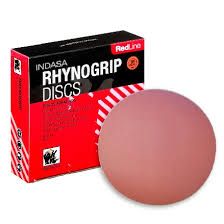
6" Indasa Rhynogrip Red Line Solid Hook & Loop Gelcoat Finishing Discs – P800–P2000
Indasa Rhynogrip Red Line 620 Series 6" Fine Finishing Discs are premium solid hook-and-loop abrasives for dry sanding gelcoat, cured fiberglass repairs, marine topcoats, paint and clear coat before compounding and polishing. Available from P800 through P2000, these no-hole discs produce a uniform scratch pattern for controlled, progressive surface refinement.
```- Available grits: P800, P1000, P1200, P1500 and P2000
- Best for: Gelcoat correction, fiberglass repair finishing and polishing preparation
- Disc size: 6 inches
- Disc pattern: Solid with no holes
- Attachment: Rhynogrip hook-and-loop
- Sanding method: Dry sanding
- Package quantity: 50 discs per box
6" Indasa Rhynogrip Red Line Solid Gelcoat Finishing Discs
Indasa Rhynogrip Red Line 620 Series discs are premium 6" solid hook-and-loop abrasives for dry fine sanding of gelcoat, fiberglass repairs, marine topcoats, paint and clear coat. Available in P800, P1000, P1200, P1500 and P2000, these discs help progressively reduce sanding scratches before compounding and polishing.
The high-quality aluminum-oxide abrasive provides dependable cutting action and a consistent scratch pattern. Flexible latex-paper backing helps the disc follow curved boat hulls, decks, molds and composite panels, while the clog-resistant lubricant coating helps maintain sanding performance on cured gelcoat and coatings.
Solid No-Hole Disc Design
The Indasa 620 Series is a solid sanding disc with no vacuum holes. The full abrasive face provides uninterrupted sanding contact across the entire 6" disc.
This configuration works well for gelcoat correction, fiberglass repair finishing, paint refinement and other applications where a solid abrasive surface is preferred. These discs do not provide through-the-disc dust extraction.
Designed for Gelcoat and Fiberglass Finishing
These fine-grit discs are intended for the finishing stages of fiberglass and gelcoat work. Use them after structural laminate grinding, fairing, filling and coarse surface leveling have already been completed.
- Refining cured gelcoat repairs
- Removing fine sanding scratches from gelcoat
- Correcting localized gelcoat texture
- Preparing fiberglass repairs for compounding
- Blending repaired areas into surrounding gelcoat
- Refining marine topcoats and clear coats
- Removing dust nibs and minor paint imperfections
- Preparing painted surfaces for compound and polish
- Micro-finishing fiberglass molds and composite parts
- Reducing the amount of heavy compounding required
Which Grit Should You Use?
| Grit | Part Number | Recommended Use |
|---|---|---|
| P800 | 620-800 | Initial fine sanding, refining P600 scratches, leveling light gelcoat texture and correcting more noticeable surface defects. |
| P1000 | 620-1000 | Refining P800 scratches, correcting lighter imperfections and beginning the pre-polish finishing sequence. |
| P1200 | 620-1200 | Fine scratch refinement on gelcoat, marine paint, topcoat and clear coat before progressing to P1500. |
| P1500 | 620-1500 | Pre-compounding refinement that reduces sanding marks and helps shorten the heavy-compounding stage. |
| P2000 | 620-2000 | Final dry-sanding refinement before applying the appropriate cutting compound and polishing system. |
Do not skip large jumps between grits. Each sanding step should completely remove the scratch pattern left by the previous grit. Clean and inspect the surface before moving to the next grit so deeper scratches are not carried into the polishing stage.
Suggested Gelcoat Finishing Sequence
- Inspect the surface and select the least aggressive grit capable of correcting the defect.
- Begin with P800 only when the surface requires meaningful leveling or refinement of P600 scratches.
- Progress through P1000, P1200, P1500 and P2000 as required.
- Remove sanding residue and clean the surface between each grit.
- Inspect the scratch pattern under bright, angled lighting.
- Continue until the previous grit pattern has been completely removed.
- Compound the surface with a product capable of removing the final sanding grit.
- Follow with a finishing polish to restore gloss and clarity.
The correct starting grit and final sanding step depend on the age, hardness and condition of the gelcoat or coating. Follow the recommendations supplied with the gelcoat, marine paint, compound and polishing system.
Why Choose Indasa Red Line?
- Uniform scratch pattern: Creates a predictable surface that is easier to refine between grit steps.
- High-quality aluminum oxide: Provides consistent cutting action throughout the finishing sequence.
- Flexible latex-paper backing: Adapts to curved hulls, decks and contoured composite surfaces.
- Clog-resistant coating: Helps reduce loading while sanding gelcoat, topcoats, paint and clear coat.
- High-strength resin bond: Helps minimize premature abrasive-grain shedding.
- Rhynogrip attachment: Allows quick grit changes during multi-stage sanding.
- Solid abrasive face: Provides full sanding coverage without vacuum holes interrupting the disc surface.
Benefits of the 6" Size
The 6" diameter covers more surface area than a 5" disc, making it efficient for boat hulls, decks, molds, automotive panels and other broad surfaces. The larger sanding footprint can improve production speed while helping maintain an even scratch pattern across larger areas.
Hook & Loop for Multi-Grit Finishing
The Rhynogrip hook-and-loop system allows discs to be changed quickly as the surface progresses from P800 through P2000. Partially used discs can also be removed and reattached when they remain in usable condition.
Use these discs with a compatible 6" hook-and-loop backing pad. Do not install them on a PSA or adhesive-only backing pad.
Use an Interface Pad on Curved Surfaces
A compatible 6" soft interface pad can be installed between the backing pad and sanding disc when working on curved hulls, rounded corners, molded parts and contoured fiberglass surfaces.
The additional flexibility helps the abrasive conform to the surface and distributes sanding pressure more evenly. Use light, controlled pressure near edges and raised areas where gelcoat can be sanded through quickly.
Dry Sanding Only
Indasa classifies Rhynogrip Red Line as a dry-sanding abrasive. Fine grit does not automatically mean an abrasive is waterproof or suitable for wet sanding.
Do not soak these discs or use them with standing water. Select a dedicated waterproof abrasive when wet sanding is required.
Not for Heavy Fiberglass Grinding
P800 through P2000 discs are designed for fine surface refinement. They are not intended to remove thick fiberglass laminate, grind structural tabbing, shape major repairs or remove heavy layers of gelcoat.
Use an appropriate coarse grinding or sanding abrasive for structural fiberglass work. Move into the Red Line fine-finishing range only after the surface has been leveled and deeper scratches have been progressively removed.
Product Specifications
- Manufacturer: Indasa
- Product line: Rhynogrip Red Line
- Series: 620 Series
- Product type: Fine-finishing sanding disc
- Diameter: 6 inches
- Disc pattern: Solid with no holes
- Attachment: Rhynogrip hook-and-loop
- Available grits: P800, P1000, P1200, P1500 and P2000
- Abrasive grain: Aluminum oxide
- Fine-grit backing: B-weight latex paper with velour grip backing
- Bond: Modified synthetic resin
- Coating: Clog-resistant lubricant coating
- Sanding method: Dry sanding
- Recommended tool: 6" dual-action or random-orbital sander
- Required pad: Compatible 6" hook-and-loop backing pad
- Package quantity: 50 discs per box
Frequently Asked Questions
Are these discs solid or perforated?
They are solid sanding discs with no vacuum holes.
What series are these discs?
These are Indasa 620 Series Rhynogrip Red Line solid sanding discs.
Can they be used to sand gelcoat?
Yes. P800 through P2000 Red Line discs are suitable for dry fine sanding and progressive scratch refinement on cured gelcoat before compounding and polishing.
Are they suitable for fiberglass repairs?
Yes, during the final finishing stages. Structural grinding, fairing and coarse leveling should be completed before using these fine grits.
Can I wet sand with these discs?
No. Rhynogrip Red Line is classified as a dry-sanding abrasive. Use a dedicated waterproof abrasive for wet sanding.
Do these discs provide dust extraction?
No. The 620 Series is solid and does not provide through-the-disc dust extraction. Use appropriate external dust control and personal protective equipment.
Should I start with P800?
Only when the surface defect or existing scratch pattern requires it. Begin with the least aggressive grit capable of correcting the surface.
Which grit should I use before compounding?
P1500 or P2000 may be used as the final sanding step, depending on the surface and the cutting ability of the selected compound.
Do I need an interface pad?
An interface pad is optional but helpful on curved hulls, rounded edges and contoured fiberglass parts.
How many discs are included?
Each box contains 50 discs in the selected grit.
Order from Fiberglass Florida
Select P800, P1000, P1200, P1500 or P2000 above. Each grit is sold as one box of 50 discs.
Fiberglass Florida ships gelcoat, fiberglass and marine finishing abrasives nationwide. Local pickup and product assistance are available through our Rockledge location in Brevard County and Stuart location in Martin County, Florida.
Need help choosing a sanding sequence, backing pad, interface pad, compound or polishing system? Call Fiberglass Florida at 321-639-3046.
```| Manufacturer | Indasa |
|---|
Please complete your information below to login.
Sign In
Create New Account