
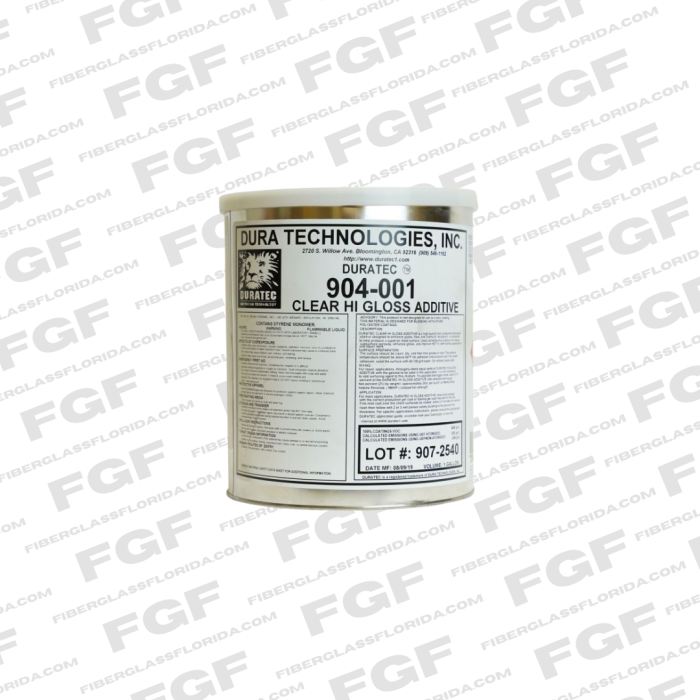
Duratec Clear Hi-Gloss Additive
Duratec Clear Hi-Gloss Additive Sold in Gallons
Add to gelcoat at a 1:1 ratio to make an easily sprayed coating that can be sprayed through most paint guns. Provides a high quality finished surface for doing repairs or finish work. Can also be used in molding to improve gelcoat properties. (904-001)
For surfacing composite plugs and patterns and for sealing woods and veneers, plaster, concrete, and GRP surfaces.
A polymer designed to blend with clear or pigmented gelcoats when used as a coating, such as in repair oversprays. When blended 1:1 with gelcoats, creates an air-cure, enamel-like coating. Duratec High Gloss Additive 904-001: Blend with gelcoat to create a repair coating or to improve the initial properties of the gelcoat. A 50:50 blend with gelcoat will air-cure, even at the thin edge of a repair. The repaired area can be polished to a gloss that goes all the way to the edge….prevent the ugly low gloss donut often seen in gelcoat repairs. Duratec 904-001 High Gloss Additive is formulated to resist yellowing and provide a stable color even with exposure to bright sunlight. Duratec 904-001 can be added to Tooling Gelcoat (15-25%) to improve air release and prevent porosity. The High Gloss Additive can be added to any Duratec Primer to improve the gloss (for patterns and molds)

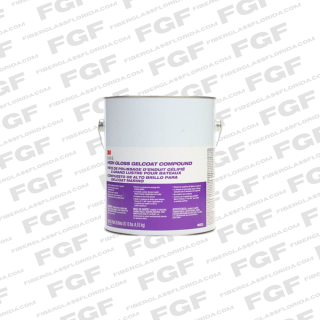
DURATEC HI-GLOSS ADDITIVE 904-001 A superior product for gelcoat repair and for enhancing tooling gelcoat properties. Blend with gelcoats for gelcoat repairs; blend with tooling gelcoats to upgrade mold surfaces. You will get a superior finish, add quality and save time and labor with Duratec Clear Hi-Gloss Additive. Why you should choose Duratec Polyester Clear Hi-Gloss Additive: ◊Low Porosity-when used for repairs, blending the additive with gelcoat produces a low porosity surface. ◊Reduced orange peel-the low viscosity of the blend results in a smooth finish that is easily sanded. ◊Improved properties-for mold surfaces, the blending of the additive with tooling gelcoat creates higher heat distortion temperature, improved gloss retention, increased impact resistance and reduced subsurface porosity. ◊Superior Finish-when blended one-to-one with gelcoats, the additive creates an air-cure, enamel-like coating No air-dry additive is required. When used for repair, surfaces are restored to like-new condition. APPLICATION GUIDE FOR DURATEC CLEAR HI-GLOSS ADDITIVE GELCOAT REPAIR The following procedure describes the use of the DURATEC CLEAR HI-GLOSS ADDITIVE in the repair of clear or pigmented gel coated FRP parts. Significant time and labor savings are generated; The end result is a smooth, high-gloss, hard surface repair that is similar in the appearance to the original gel coat surface. Ambient temperature should be in excess of 60°F to ensure a rapid and complete cure. 1) Thoroughly sand the area to be repaired to a 80-180 grit finish and remove all dirt, wax and grease from the surface. 2) Blend and mix completely equal parts of the DURATEC CLEAR HI-GLOSS ADDITVE and the desired gel coat required for the repair or entire overspray. Catalyze with a full 2% of mekP catalyst (20 cc per quart). Thin with a fast lacquer-thinner or mek solvent if desired. 3) Spray the entire surface to be repaired with a fine mist coat and wait 2 minutes for the solvents to flash off. Follow with wet coats, overlapping the surrounding area to insure complete coverage. Note:Spray pressures should be 35-50 psi. If a pressure pot is used, provide 10-15 psi pot pressure. 4) Do not inhibit the cure by adding wax surfacing agents as the combined gel coat and DURATEC CLEAR HI-GLOSS ADDITIVE will air cure to a hard, glossy finish in approximately 1-2 hours. (Apply forced-air-heat for a 20 minute cure time). 5) Lightly sand the repaired area with 220-600 grit sandpaper, either wet or dry, and buff to the desired finish, insuring that the newly gel coated area is blended with the surrounding gel coat surface. TOOLING GELCOAT UPGRADE The following procedure describes the addition of from five to fifteen percent (5-15%) of the DURATEC CLEAR HI-GLOSS ADDITIVE to tooling gelcoat to achieve the following property improvements; reduced subsurface porosity and orange-peel, increased impact resistance, improved gloss retention and higher heat distortion temperature. 1) Blend the DURATEC CLEAR HI-GLOSS ADDITIVE @ 5-15% to the tooling gelcoat; the viscosity and thix properties of the gelcoat will determine the quantity to be added. 2) After blending, catalyze at the rate suggested by the gelcoat manufacturer. 3) Spray as recommended by the gelcoat manufacturer. NOTE:Due to the lower viscosity, an extra wet-pass may be required to achieve total film thickness. Gel and tack times are comparable to the straight tooling gelcoat.
| Featured | yes |
|---|
Downloads
SDS Safety Data Sheet
-
 Duratec Clear Hi-Gloss Additive Size: (226.65 KB) Downloads: 632
TDS Technical Data Sheet
- Duratec Clear Hi-Gloss Additive Size: (1.36 MB) Downloads: 583
Validate your login