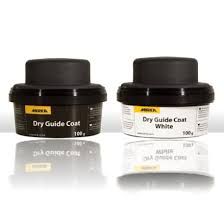
Mirka Dry Guide Black & White

In stock
SKU
mdryguide
As low as $42.78
Quick Overview

Mirka Dry Guide Coat is a dry, powder-based sanding guide designed to reveal surface imperfections such as low spots, scratches, and pinholes during sanding. Available in black and white 100 g containers, it provides fast, clean visual feedback on gelcoat, paint, fiberglass, and composite surfaces.
Dry Guide Coat for Accurate Surface Preparation

Mirka Dry Guide Coat is a professional-grade, powder-based sanding guide used to identify surface imperfections during sanding and surface preparation. When applied lightly to the surface, the powder highlights low spots, scratches, pinholes, and uneven areas, allowing for precise correction before moving to the next sanding or finishing step.

Unlike liquid guide coats, Mirka Dry Guide Coat requires no masking time, drying time, or solvents, making it a clean and efficient solution for marine, automotive, and composite applications.

Available Colors (100 g Containers)

  • Black – Ideal for light-colored surfaces and primers
  • White – Best for dark surfaces, gelcoat, and paint

Ideal Applications

  • Gelcoat sanding and fairing
  • Fiberglass and composite surface prep
  • Automotive bodywork and refinishing
  • Primer and paint sanding
  • Marine repair and refinishing

Key Benefits

  • Reveals scratches, low spots, and surface defects
  • No drying time or solvents required
  • Clean, dry application
  • Compatible with hand sanding and machine sanding
  • Available in black and white for maximum contrast

How to Use

  1. Apply a light, even layer of dry guide coat to the surface.
  2. Sand the surface as normal using the appropriate abrasive.
  3. Observe remaining guide coat to identify low spots or imperfections.
  4. Continue sanding or filling as needed until the guide coat is fully removed.

Mirka Dry Guide Coat is an essential tool for achieving flat, uniform surfaces before polishing, painting, or final finishing.

If you need help selecting abrasives or building a complete sanding system, contact us at orders@fiberglassflorida.com or call 321-639-3046 for expert support.

0
Rating:
0% of 100
Write Your Own Review
You're reviewing:Mirka Dry Guide Black & White
Your Rating
Customer Questions
What is Q-Cell used for?
Q-Cell, or microballoons, are hollow glass or phenolic
microspheres that are lightweight and add volume to the
resin or epoxy mixture. They are primarily used as a filler
to reduce density, increase volume, and improve
sandability. Q-Cell...
How Much Does 4-Pound Pour Foam Expand and What Volume Will It Fill?
How Much Does 4-Pound Pour Foam Expand and What Volume Will It Fill? Four-pound density polyurethane pour foam is a closed-cell marine foam with greater strength and compression resistance than 2-pound foam. It is commonly used in structural applications...
Which products would you use to buff and polish your boat?
Presta Gelcoat Compound: Ideal for restoring the finish on gelcoat surfaces, this compound effectively removes oxidation and imperfections, leaving a smooth, high-gloss finish. Presta Chroma Ultra Polish: This product...
Which Adtech (now Sika) filler should I use—P-11 (AP112), P-14, P-17, or P-77?
Adtech (Sika) Marine Fillers: How to Choose — P-14, P-11/AP112, P-17, P-77/AP077 Quick pick: For most boat fairing and everyday bonding, choose P-14 Ultra Filler (our top seller). Use P-11/AP112 when...
What’s the proper sanding and wet-sanding grit progression to finish gel coat before buffing?
What’s the proper sanding and wet-sanding grit progression to finish gel coat before buffing? Confirm cure & film build: Only sand fully cured gel coat. If the film is thin (e.g., small repair), start with finer grits to avoid...
What pads, compounds, and polishes should I use after wet-sanding gel coat?
What pads, compounds, and polishes should I use after wet-sanding gel coat? Compounding (cut): Use a wool cutting pad (Buff and Shine®) with a quality marine cutting compound (Starke® or Presta®). ...
Why is timing critical when building a polyester tooling mold?
Most polyester tooling molds are built using contact (open) molding, where tooling gel coat is applied first and allowed to gel before laminating. The laminate bonds to the cured gel coat through a secondary bond, which is inherently weaker than a ...
What type of tooling gel coat should be used for mold construction?
Tooling gel coat selection directly impacts mold surface quality, durability, and heat resistance. Isophthalic polyester tooling gel coats provide the highest natural gloss and smoothness but offer moderate strength and heat distortion temperature (...
What is the purpose of a barrier coat in tooling applications?
Barrier coats, typically vinyl ester based, are applied between the tooling gel coat and the laminate. Their primary function is to block fiber print-through and reduce surface distortion in the finished mold. Barrier coats also reinforce the ...
Marine Pour Foam – Mix Ratios, Expansion Volumes, and Density Guide
Marine Pour Foam – Mix Ratios, Expansion Volumes, and Density Guide Marine pour foam, also called expanding foam, is a two-part closed-cell polyurethane foam used for flotation, insulation, and cavity filling. At
Please, mind that only logged in users can submit questions